
Buying
Having a Property Purchase Contract Reviewed in 2026: Checkpoints, Costs, Process
A real estate purchase contract binds you for decades. Having it reviewed before signing helps you avoid costly pitfalls related to encumbrances, deadlines, and ancillary costs. This overview covers key checkpoints, fee models, and the typical process in Austria.
Last updated on 28 October 2026
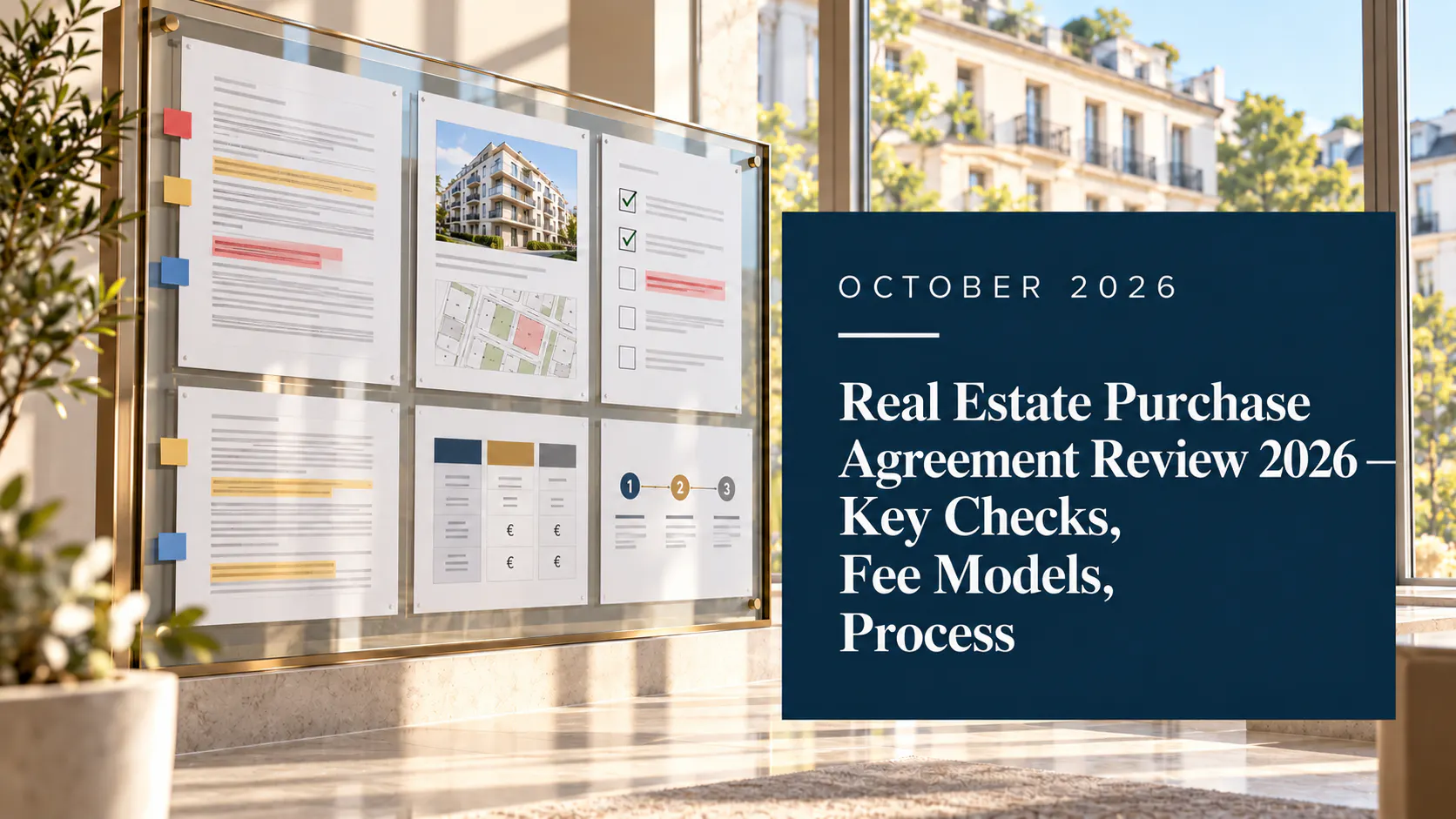
Anyone buying or selling property in Austria usually signs only once — and that’s exactly what makes the matter delicate. Many buyers receive the draft purchase contract only shortly before the scheduled signing date and have little time to truly understand clauses on warranty, withdrawal rights, or the release of encumbrances. This is often the point at which it’s decided whether a purchase goes smoothly or whether costly disputes arise later.
Bring the contract draft, the current land register extract, the energy performance certificate, and — if available — the most recent operating cost statement, along with questions about deadlines and payment terms, to an initial consultation. Simon Immobilien helps classify documents and connects you with the right contacts for an in-depth legal review — this does not replace actual legal advice.
Key takeaways
- A real estate purchase contract in Austria should generally be reviewed by a qualified professional before signing, since it takes effect in the land register and is barely correctable afterward.
- Notaries and lawyers offer different fee models, from flat rates to hourly rates — comparing them is worthwhile.
- Central checkpoints include the release of encumbrances, deadlines, warranty provisions, withdrawal rights, and correct registrability in the land register.
- Escrow handling through a notary or lawyer protects both sides during payment of the purchase price, but creates additional costs.
- Real estate transfer tax (Grunderwerbsteuer) at 3.5% and the registration fee (Eintragungsgebühr) at 1.1% are fixed statutory ancillary costs that belong in every calculation.
- This article does not replace individual legal advice — it offers orientation so that conversations with a notary, lawyer, or tax advisor can be conducted more purposefully.
Why a contract review is necessary at all
A real estate purchase contract regulates far more than the purchase price and handover date. It determines who bears which risks if defects appear after the purchase, how existing encumbrances in the land register are handled, and under what conditions withdrawal is possible. In Austria, the General Civil Code (ABGB) forms the basis for warranty and contract law, supplemented by more specific regulations such as the Condominium Act (WEG) for owner-occupied apartments or the Tenancy Act (MRG) if the property is rented and the lease is being transferred along with it.
The contract review is relevant for practically all groups of buyers: first-time buyers of a condominium as much as experienced investors acquiring an apartment building, or sellers who want to ensure the contract doesn’t hold them liable for an unnecessarily long time through warranty clauses. The typical starting situation looks like this: the broker or seller’s side presents a draft contract, often drawn up by a notary’s office or law firm that is handling the escrow process anyway. Buyers then often assume that this draft is neutral — in fact, the commissioning party is generally primarily represented, even though notaries act as independent certifying officials. A second, independent review creates security here without calling the trustworthiness of the process into question.
The legal framework in Austria differs from Germany in that notarial certification is not mandatory for a standard property purchase — however, the signatures must be certified for registration in the land register, which in turn is done by a notary or in court. This particularity often leads to misunderstandings about who actually reviews the contract in the process and who merely certifies it.
Terms and misunderstandings worth clarifying
Contract drafting versus contract review
Contract drafting is the creation of the purchase contract, usually by a notary or lawyer on behalf of one of the parties. Contract review is a separate step: a second qualified person reads through the finished or draft contract and evaluates it from the other party’s perspective. Ideally, the person who drafted the contract should not be the same person reviewing it for the other side — if only because of potential conflicts of interest.
Escrow handling (Treuhandabwicklung)
With escrow handling, a neutral party — usually a notary or lawyer — holds back the purchase price until certain conditions are met, such as the release of encumbrances in the land register or the priority ranking (Rangordnung) for the intended sale. This protects buyers from the situation of paying the purchase price before actually receiving unencumbered ownership, and protects sellers from transferring ownership without actually receiving the money.
Warranty and exclusion of liability
Many contracts contain clauses that limit or exclude warranty for material defects, especially for older existing properties. This is legally permissible but should be read carefully — a complete exclusion of warranty means that defects discovered later, for example in the building structure, generally remain the buyer’s responsibility. A common misunderstanding: defects fraudulently concealed are generally not covered by a warranty exclusion, though the distinction in individual cases is a legal question.
What specifically matters in the review
A thorough contract review doesn’t just look at the purchase price, but at a series of individual points that together determine the economic risk. These include in particular:
- Release of encumbrances: Are liens, easements, or other encumbrances registered in the land register clearly regulated regarding who removes them and by when.
- Deadlines: Payment deadlines, handover date, withdrawal periods, and deadlines for escrow handling must be realistic and coordinated with one another.
- Registrability: The contract must be worded so that the land registry court actually accepts it — unclear area specifications or missing approvals lead to delays.
- Warranty and description of condition: How detailed is the description of the current condition, which defects are known and documented.
- Contractual penalties and withdrawal rights: Under what conditions can a party withdraw from the contract, and what consequences does that have.
- Ancillary costs and cost allocation: Who pays for contract drafting, real estate transfer tax, registration fee, and any broker’s commission.
The fee models for the review itself differ noticeably. Some law firms charge a flat fee for simply reviewing a finished draft, others bill by the hour, especially when renegotiations with the other side become necessary. A rough comparison:
| Model | Typical billing | 特点特点 |
|---|---|---|
| Flat fee for contract review | Fixed price per draft | Predictable, usually for simple standard contracts |
| Hourly rate, lawyer/notary | Based on effort | Sensible for more complex cases requiring renegotiation |
| Fee based on transaction value | Tiered by purchase price | Common for contract drafting, not for pure review |
| Escrow fee | Fixed percentage or flat rate | Separate service, often linked to the notary |
Which model is more favorable in an individual case depends heavily on the property. For a straightforward condominium with no tenancy, a flat-fee review is usually sufficient. For apartment buildings, properties with existing leases under the MRG, or developer contracts, an in-depth review billed by effort is often worthwhile, since significantly more clauses must be individually negotiated here.
The contract review process step by step
- Request the draft: Buyer or seller requests the contract draft early, ideally several days before the planned signing date.
- Obtain a land register extract: A current extract shows existing encumbrances and is the basis for every review; it usually takes a few hours to a day via the electronic land register.
- Commission a qualified review: A lawyer or notary checks the contract against the land register status; duration depends on complexity, ranging from a few days to around a week.
- Queries and renegotiation: Unclear or unfavorable clauses are coordinated with the other side or their contract drafter; the duration varies considerably.
- Signing and certification: Signatures are certified by a notary or court, usually at one appointment.
- Escrow handling: The purchase price is deposited in escrow, the release of encumbrances and due-date conditions are processed, typically taking a few weeks.
- Land register entry: After release by the escrow agent, the entry is made in the land register at the competent district court; processing time varies depending on the court.
During this process, several parties are often involved in parallel: the financing bank checks the collateral, the tax advisor calculates tax implications for rented properties, and a broker accompanies communication between the parties. Anyone wanting an overview of comparable properties beforehand can find orientation on price levels and standard of fittings in various locations in the current property listings from Simon Immobilien.
Worked example: Ancillary costs and review effort compared
For orientation, here is an indicative scenario, not a binding calculation: A condominium is sold for 350,000 euros. The real estate transfer tax of 3.5% amounts to 12,250 euros, the registration fee of 1.1% comes to 3,850 euros — both rates are fixed by law. For contract drafting including escrow handling, a fee is often negotiated based on transaction value and agreed individually; no reliable flat percentage can seriously be given here, since law firms calculate differently. If an independent contract review by a second law firm is additionally commissioned, a further, separately agreed fee is added.
In the second scenario, the purchase of an apartment building for 1.2 million euros with several existing tenancies, the real estate transfer tax is 42,000 euros, and the registration fee is 13,200 euros. Here, the review effort increases significantly: existing leases under the MRG must be checked for fixed terms, rent calculation, and protection against termination, which increases the time required and, with hourly fees, the cost of the review as well. This difference shows why a flat cost comparison between properties is of limited value — the review effort depends more on legal complexity than on the pure purchase price.
Typical mistakes and how to avoid them
The contract is read for the first time only at the signing appointment: Without enough time for queries, there is hardly any room to change unfavorable clauses before certification takes place.
The land register extract is not obtained in a current form: Between the contract draft and signing, encumbrances can change, and an outdated extract overlooks this.
Escrow handling is dismissed as a mere formality: If the purchase price is transferred directly without escrow binding, one side bears a significant risk of default.
The warranty exclusion is overlooked: Especially with older existing buildings, a complete exclusion can shift all later renovation costs entirely to the buyer’s side.
Deadlines are calculated too tightly: Bank financing, land register entry, and escrow handling need realistic time buffers, otherwise default consequences threaten.
Ancillary costs are only calculated after signing the contract: Anyone who only takes real estate transfer tax, registration fee, and professional fees into account afterward risks a financing gap.
Checklist: before signing
- Obtain a current land register extract and check for encumbrances.
- Request the contract draft at least a few days before the appointment.
- Commission an independent review by a lawyer or notary.
- Review warranty clauses for scope and exclusions.
- Clarify escrow conditions and due-date requirements.
- Cross-check deadlines for payment, handover, and withdrawal.
- Calculate ancillary costs in full, including tax and fees.
- For rented properties, have existing leases reviewed under the MRG.
- Compare the energy performance certificate and description of condition against the actual state.
- Align the bank’s financing commitment in time with the contract timeline.
Frequently asked questions
Does a real estate purchase contract in Austria have to be notarized?
Notarial certification in the strict sense is not mandatory for a standard property purchase. However, signatures must be certified for entry in the land register, which is usually done by a notary or a court.
How long does it take for a buyer to be registered as owner in the land register?
After signing and escrow handling, the duration depends on the competent district court and the completeness of the documents. Reliable blanket time estimates are not very credible here; the accompanying law firm can give a rough assessment.
Is an additional contract review worthwhile if the notary is independent anyway?
Notaries are obliged to act impartially, but are often commissioned by one of the contracting parties to draft the contract. An additional review by a separately commissioned person can provide extra security, especially for more complex contracts.
What happens if a defect appears after signing?
This depends significantly on whether and to what extent the warranty was excluded in the contract and whether the defect was fraudulently concealed. A blanket answer is not possible here; the assessment is a matter for the individual case and should be reviewed legally.
Who usually bears the costs of drafting the contract?
This is agreed contractually and varies depending on negotiating position and regional practice. Often the buyer’s side bears most of the ancillary costs, but this is not mandatory.
How Simon Immobilien supports you
Simon Immobilien accompanies purchase and sale processes with market valuation, marketing, and coordination between the parties involved, but this does not replace a legal or notarial review of the purchase contract. Anyone with questions about the process, deadlines, or the classification of a specific contract draft can arrange a no-obligation conversation via the Simon Immobilien contact page. Further background on related topics can also be found in the property guide, for example on financing, valuation, or regional particularities via the location guides.
This article serves general orientation purposes and does not replace individual legal or tax advice.
More from Buying
Personal consultation
Questions about your property? We take the time.
Whether buying, selling, valuation or financing — let's discuss your situation in a non-binding appointment.