
Buying
Reviewing a Purchase Contract: 25 Clauses Buyers in Austria Need to Know
A real estate purchase contract determines years of peace of mind or years of trouble. This guide explains the most important clauses, common pitfalls, and the process from signing to land registry entry — in clear, practical terms.
Last updated on 29 October 2026
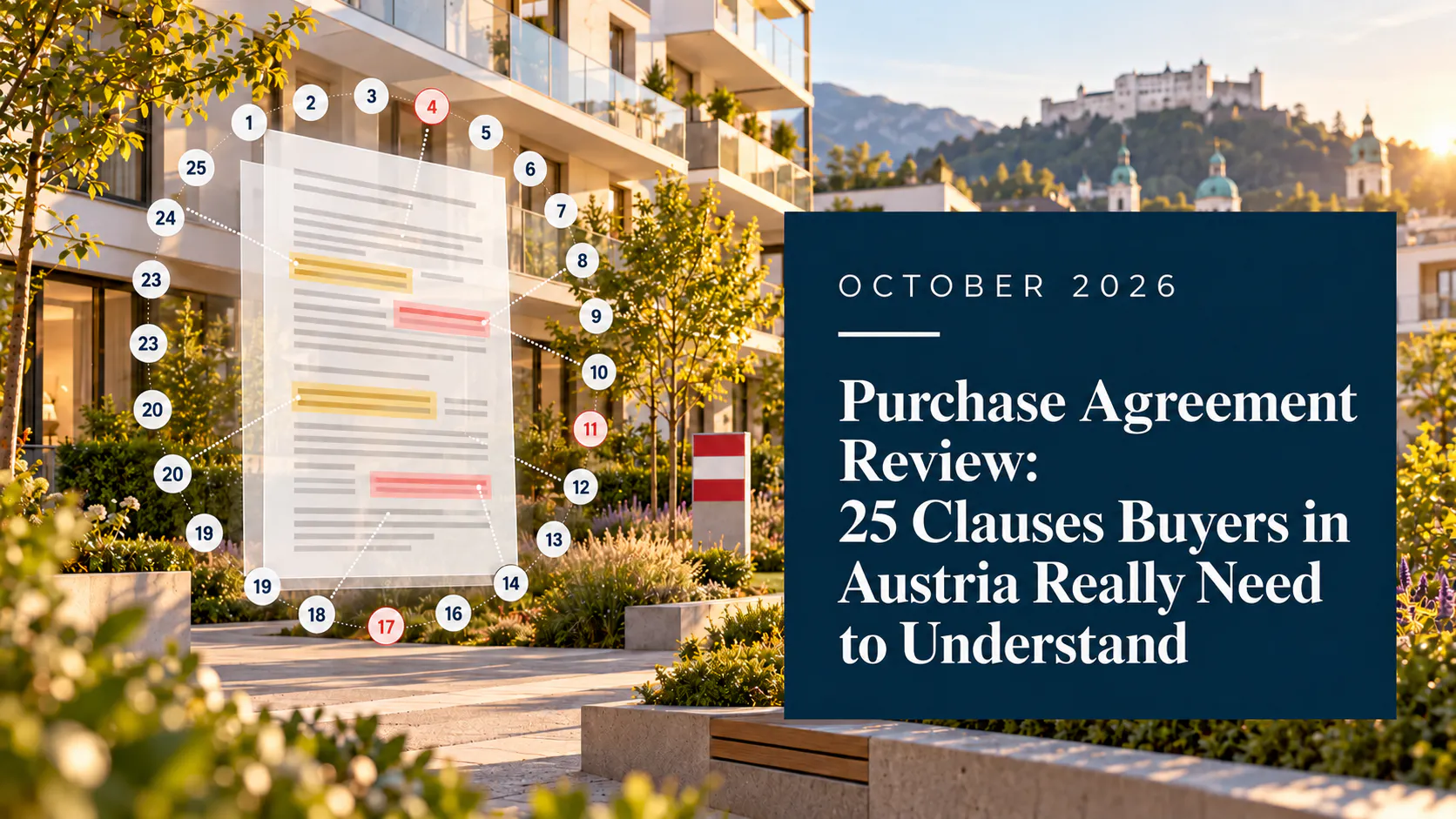
Anyone buying an apartment or house in Austria usually signs a purchase contract of this magnitude only once in their life. The contract is long, written in legal language, and contains clauses whose significance often only becomes apparent in a dispute. Many buyers trust that the notary or contract drafter has already taken care of everything important — and in doing so overlook points that can become costly later.
Bring the contract draft, the land registry extract, current operating cost statements, and any open questions about deadlines or warranty to your consultation. Simon Immobilien helps you classify clauses and flag anything unusual, but does not replace individual legal advice from a notary or lawyer.
The Most Important Points at a Glance
- A purchase contract in Austria must be concluded in writing so that it can be entered in the land registry.
- Warranty exclusions, due-date clauses and contractual penalties are the sections carrying the greatest financial risk.
- Real estate transfer tax (Grunderwerbsteuer) is fixed by law at 3.5 percent, and the land registry entry fee at 1.1 percent of the assessment base.
- Escrow handling (Treuhandabwicklung) through a notary or lawyer protects both parties from payment defaults and double registration.
- Encumbrances, easements and pre-emption rights entered in the land registry can significantly limit the value and usability of the property.
- Having the contract draft professionally reviewed before signing avoids the most expensive mistakes in the entire purchase process.
Why the Purchase Contract Is More Than a Formality
A real estate purchase contract does not just set the price and handover date. It determines who bears which risks, how defects are handled, when possession and risk transfer, and what happens if one party fails to meet its obligations. In Austria, the contract is based on the General Civil Code (Allgemeines Bürgerliches Gesetzbuch, ABGB); for condominiums, the Condominium Act (Wohnungseigentumsgesetz, WEG) also applies. For rented properties, the Tenancy Act (Mietrechtsgesetz, MRG) often plays a role too, for example when existing tenancies are taken over.
This topic is relevant to anyone buying a used property, a newly built apartment, or a plot of land — regardless of whether it’s a first condominium, an investment property, or a single-family house on the outskirts of town. The starting point is usually similar: the contract draft is on the table, financing is secured or being finalized, and there is little time to calmly think through every single clause. It is precisely in this phase that most mistakes happen — not out of carelessness, but due to time pressure and unfamiliarity with contract language.
Legally, there is no obligation in Austria to have a purchase contract reviewed by a lawyer. However, registration in the land registry requires the involvement of a notary or lawyer anyway, since signatures must be certified. This person often also drafts the contract but in practice frequently represents both parties jointly — a fact buyers should be aware of so as not to assume one-sided representation of their interests.
Basic Terms Every Buyer Should Understand
Warranty and Liability Exclusion
The warranty (Gewährleistung) determines who is liable for defects that already existed at the time of handover. For used properties, the warranty is often contractually limited or excluded — this is permissible in Austria as long as the seller does not fraudulently conceal defects. Buyers should read carefully whether the exclusion also covers hidden defects and whether it applies to the entire property or only parts of it.
Release of Encumbrances
This clause stipulates that existing mortgages, liens or other encumbrances are to be cleared before or in the course of the purchase price payment. Without a clear release-of-encumbrances clause, there is a risk that the buyer acquires a property still carrying someone else’s debt.
Easements and Pre-emption Rights
Rights of way, utility easements or third-party pre-emption rights entered in the land registry generally remain in place even if the contract does not explicitly mention them. A common misunderstanding is the assumption that all encumbrances automatically lapse upon transfer of ownership — this only applies to those that are explicitly deleted.
Escrow (Treuhandschaft)
Escrow handling through a notary or lawyer ensures that the purchase price is only paid out to the seller once the transfer of ownership is secured in the land registry. This arrangement protects both parties and is standard practice in most transactions in Austria.
What Really Matters When Reviewing the Contract
Not every clause carries the same weight. For a practical review, it is worth weighting clauses by financial risk and likelihood of occurrence.
- Purchase price, due date and payment terms: Do the amount, installment schedule and bank details match the financing commitment.
- Handover date and condition at handover: What fittings and defects are documented, and who bears the risk until handover.
- Warranty provisions: Scope, duration and possible exclusions in detail.
- Contractual penalties for withdrawal or default: Check the amount and the triggering conditions carefully.
- Land registry status: Encumbrances, easements, pre-emption rights, pending proceedings.
- Allocation of ancillary costs: Who pays the broker’s commission, contract drafting, real estate transfer tax and registration fee.
- For condominiums: Reserve fund balance, resolutions of the owners’ association, ongoing renovation projects.
The following table shows the main cost items that play a role in practically every Austrian purchase contract:
| Cost item | Amount | Note |
|---|---|---|
| Real estate transfer tax (Grunderwerbsteuer) | 3.5% of purchase price | fixed by law, Federal Ministry of Finance |
| Land registry entry fee | 1.1% of purchase price | fixed by law |
| Contract drafting (notary/lawyer) | by agreement | depends on firm and effort involved |
| Escrow handling | by agreement | often listed as a separate item |
| Broker’s commission | capped by law | depends on purchase price and federal state |
Process from Signing the Contract to Land Registry Entry
- Review the contract draft (before signing, ideally with professional input): usually takes several days, as queries to the seller or contract drafter may be necessary.
- Signing with notarial or legal certification of signatures: typically a single appointment.
- The trustee sets up an escrow account; the buyer transfers the purchase price and ancillary costs to it: usually a few business days, depending on bank processing.
- Self-assessment and remittance of the real estate transfer tax to the tax office by the contract drafter.
- The land registry application is filed with the competent district court: processing time varies by court, often several weeks.
- The release of encumbrances is carried out once registered liens have been deleted.
- The trustee pays out the purchase price to the seller as soon as the transfer of ownership is secured in the land registry.
- Handover of the property with a record of meter readings, keys and condition.
Those who want additional orientation can find background information on infrastructure and development in individual areas in the location guides for regions, which can help in assessing the property being purchased.
Worked Example: Ancillary Costs When Buying an Apartment
The following example, using assumed figures, serves as a point of orientation for a condominium with a purchase price of 350,000 euros.
The real estate transfer tax is fixed by law at 3.5 percent, amounting to 12,250 euros. The land registry entry fee is fixed by law at 1.1 percent, amounting to 3,850 euros. For contract drafting and escrow handling, this example assumes a guideline value of around 1.5 to 2 percent of the purchase price, i.e. between 5,250 and 7,000 euros — the actual amount depends on the firm engaged and should be requested in writing in advance. In total, this results in ancillary costs in the range of roughly 21,000 to 23,000 euros on top of the purchase price, excluding the broker’s commission.
For comparison, a second scenario: for a purchase price of 180,000 euros for a smaller apartment outside the provincial capitals, 6,300 euros in real estate transfer tax and 1,980 euros in registration fee apply. Contract costs, assumed at 1.5 to 2 percent, are correspondingly lower, at around 2,700 to 3,600 euros. In total, ancillary costs here amount to roughly 11,000 to 12,000 euros. This comparison shows that the legally fixed taxes rise linearly with the purchase price, while contract costs vary by firm and are separately negotiable.
Typical Mistakes and How to Avoid Them
A common mistake is signing under time pressure without having calmly read the contract beforehand. Anyone who sees the full text for the first time at the certification appointment can hardly still scrutinize the clauses objectively.
It is equally risky to overlook the warranty exclusion and only be surprised by defects after moving in that have already been contractually excluded from liability. A careful look at the handover protocol can provide clarity beforehand.
Many buyers do not review the land registry extract themselves but rely solely on the contract drafter’s summary. Registered easements or a prohibition on encumbrance and sale in favor of third parties are sometimes only discovered late as a result.
Another classic issue: the due date for the purchase price is agreed before the bank’s financing commitment is finally in place. If financing stalls, contractual penalties for payment default may be triggered.
Finally, some buyers underestimate the importance of the reserve fund for condominiums. A reserve fund that is too low can lead to high special payments shortly after purchase, for example when facade or roof renovations are due.
Checklist: Purchase Contract Before Signing
- Read the land registry extract yourself and understood the encumbrances
- Checked the warranty clause for scope and exclusions
- Matched the due date of the purchase price with the financing commitment
- Specifically defined the handover date and condition at handover
- Understood contractual penalties for withdrawal or default
- Clarified ancillary costs and their allocation in writing
- For condominiums: reviewed reserve fund, resolutions and ongoing renovations
- Understood the escrow arrangement and payout conditions
- Discussed open questions with a notary or independent advisor
Frequently Asked Questions
Do I have to have the purchase contract reviewed by my own lawyer?
There is no legal obligation to do so. Since the contract drafter in practice often represents both parties, an additional, independent review can nevertheless be advisable, especially for more complex contracts or unusual clauses.
What happens if I discover defects after signing?
This depends on the agreed scope of warranty. If the warranty was effectively excluded, claims generally only exist for defects that were fraudulently concealed, which is difficult to prove in practice.
Who pays the real estate transfer tax and the land registry entry fee?
Typically the buyer bears both charges, since they are acquiring ownership. This allocation can be arranged differently by contract, but in practice it is standard in Austria.
How long does it take until I am registered as owner in the land registry?
The duration depends on the competent district court and the completeness of the documents. Realistically, you should plan for several weeks before the land registry decision is legally delivered and becomes final.
Can I still withdraw from the purchase contract after signing?
Withdrawal is generally only possible if the contract contains corresponding clauses or statutory withdrawal rights apply, for example in consumer transactions under certain conditions. Without such provisions, a unilateral withdrawal is usually associated with contractual penalties or claims for damages.
What does a prohibition on encumbrance and sale in the land registry mean?
It restricts the ability to resell or encumber the property for as long as the prohibition is registered. Before buying, it should be clarified whether and when such a prohibition will be deleted.
How Simon Immobilien Supports You
Simon Immobilien supports buyers in classifying contract drafts, explains technical terms in the context of the specific property, and refers clients to notaries or lawyers for detailed legal review when needed. Anyone wanting an overview of current properties can find them in the current property listings, and further topics around the purchase process in the property guide. For a personal assessment of your own plans, contact Simon Immobilien.
This article does not replace individual legal advice from a notary, lawyer or tax advisor.
More from Buying
Personal consultation
Questions about your property? We take the time.
Whether buying, selling, valuation or financing — let's discuss your situation in a non-binding appointment.