
Real Estate Agent Commission in Transactions Involving Ownership Interests: Own Transactions and Close Relationships
When does an ownership interest rule out a real estate agent’s commission? A clear explanation of how to distinguish an own transaction, an economic connection, and the required disclosure of close relationships.

Real Estate Broker Shareholdings and Commission in Austria: When Is No Commission Payable?
A real estate broker’s interest in the selling company does not automatically mean that no commission may be charged. The decisive factors are how closely the broker and seller are economically connected and how much influence the broker can exercise over the selling company.
Under Austrian law, three different situations must be distinguished:
- the broker becomes a party to the transaction,
- the transaction is economically equivalent to self-dealing by the broker,
- another relevant family or economic relationship exists.
These situations have different consequences. No commission is payable in the case of genuine self-dealing or an economically equivalent transaction. If only another relevant close relationship exists, the broker may retain the right to commission, provided the client was informed without delay and all other requirements are met.
Last updated: October 2026
The Key Points in 30 Seconds
- If a broker sells their own property, no transaction with a third party is being brokered. Therefore, no commission is payable.
- The same applies if the transaction is economically equivalent to a contract concluded by the broker directly.
- In the case of corporate links, the broker’s controlling influence over the selling or letting company is particularly relevant.
- A specific percentage shareholding does not automatically determine whether commission is payable.
- Any other relevant family or economic relationship must be disclosed without delay.
- Disclosure cannot make genuine or economically equivalent self-dealing subject to commission.
- When dealing with consumers, the commission, expected costs, dual-agency activity and relevant close relationships must generally be disclosed in writing.
- The company register extract, brokerage agreement, cost statement, property particulars and correspondence should be reviewed together.
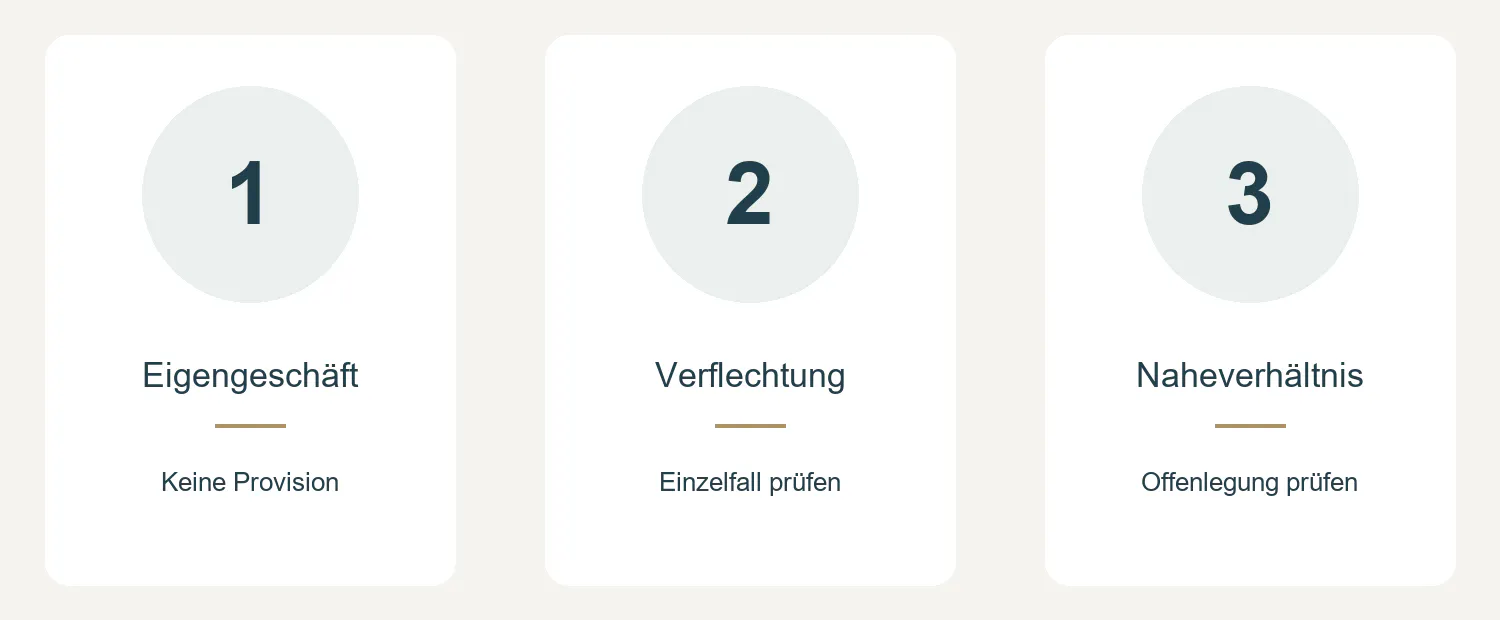
Self-dealing, economically equivalent transactions and other close relationships must be assessed separately under Austrian law.
Which Legal Provision Applies?
The central provision is Section 6(4) of the Austrian Real Estate Brokerage Act.
It distinguishes between three situations:
- If the broker becomes a party to the transaction, no commission is payable.
- The same applies if the transaction concluded with a third party is economically equivalent to a transaction concluded by the broker directly.
- If another family or economic relationship exists that could affect the broker’s ability to protect the client’s interests, commission is payable only if the broker informs the client of that relationship without delay.
The purpose of this rule is to prevent conflicts of interest. As a general principle, brokerage commission requires the broker to arrange a transaction between the client and a third party.
Situation 1: The Broker Becomes a Party to the Transaction
A classic case of self-dealing occurs when the broker sells or lets their own property.
Example
A real estate broker personally owns an apartment. The broker advertises the apartment, conducts the viewing and sells it directly to an interested buyer.
In this situation, the broker is not arranging a transaction with a third party. The broker is the seller. Under Section 6(4) of the Austrian Real Estate Brokerage Act, no brokerage commission is payable.
A statement such as “The seller is also a real estate broker” does not change this result. Disclosure does not create a commission entitlement for a self-dealing transaction.
Situation 2: An Economically Equivalent Self-Dealing Transaction
The situation is more complex if the property formally belongs to a legally independent company but the broker is economically closely connected to that company.
The Austrian Real Estate Brokerage Act therefore also covers transactions that are economically equivalent to a contract concluded by the broker directly.
According to Austrian case law, an economically equivalent transaction may exist, in particular, where the broker has a controlling influence over the selling or letting company because of corporate links. The rule is intended to prevent structures designed to circumvent the prohibition on commission for self-dealing. Austrian case-law principle concerning economically equivalent self-dealing
What Constitutes Controlling Influence?
The following factors may establish or strengthen a broker’s controlling influence:
- a majority shareholding,
- special voting rights,
- a position as sole or controlling managing director,
- direct or indirect interests held through other companies,
- economic dependencies,
- agreements concerning the distribution of the sale proceeds or commission,
- a structure under which the brokerage company is economically aligned with the seller.
The actual economic circumstances are decisive. A percentage shareholding viewed in isolation therefore does not provide a reliable answer in every case.
The Shareholding Percentage Alone Is Not Decisive
A minority interest does not automatically mean that commission is excluded. Nor does it automatically mean that the commission claim is unobjectionable.
Similarly, a majority interest should not be assessed without considering the company’s overall ownership and control structure.
The following questions are particularly relevant:
- Who owns the shares in the brokerage company?
- Who owns the shares in the selling company?
- Are indirect interests held through other companies?
- Who can appoint or dismiss the managing directors?
- Who controls the sale from an economic perspective?
- Who ultimately receives the commission?
- Are special rights or voting agreements in place?
- Was the brokerage company inserted into the structure merely as a formality?
- Are there genuinely three economically distinct parties?
In its decision 3 Ob 212/19a, the Austrian Supreme Court emphasised that the specific interests involved and the actual corporate influence must be examined.
In that case, the particular links were not sufficient to treat the brokerage company as economically identical to the seller. However, the decision does not establish a generally applicable safe-harbour percentage for shareholdings.
Situation 3: Another Family or Economic Relationship
Not every family or economic connection constitutes self-dealing for which commission is excluded.
A close relationship may exist below that threshold if it could affect the broker’s ability to protect the client’s interests.
Possible examples include:
- the seller is a close relative of the broker,
- the broker and seller hold interests in affiliated companies,
- the parties have shared economic interests,
- the broker regularly works particularly closely with the seller or property developer,
- the same individual holds a management position in both companies,
- the broker benefits from the seller’s economic success in addition to receiving commission.
In these situations, the broker may retain the right to commission. However, the broker must inform the client of the relevant relationship without delay.
What Does “Without Delay” Mean?
The relationship must be disclosed early enough for the client to consider it when making a decision.
When dealing with consumers, the information must generally be included in the written cost statement. It must be provided no later than before the client makes a contractual declaration concerning the proposed transaction.
A notice provided only after the purchase offer has been signed, after the main transaction has been concluded or together with the commission invoice may be too late.
Whether disclosure was sufficiently clear and timely depends on the content, form and timing of the information in the particular case.
What Information Should the Disclosure Contain?
A general statement such as “An economic relationship exists” may leave important questions unanswered.
Transparent information should make it possible to understand:
- between which individuals or companies the relationship exists,
- the nature of that relationship,
- whether shareholdings or overlapping management positions exist,
- the broker’s role in the transaction,
- whether the broker is also acting for the other party,
- the commission being charged to the client.
The law does not necessarily require the broker to provide the client with a complete corporate-law analysis. However, the information should be sufficiently specific for the client to recognise the potential conflict of interest.
Which Information Duties Apply to Consumers?
For consumer transactions, Section 30b of the Austrian Consumer Protection Act supplements the broker’s duties.
Before the brokerage agreement is concluded, the consumer must generally receive a written statement showing:
- that the real estate broker is acting as a broker,
- the costs expected to arise from the proposed transaction,
- the amount of the brokerage commission,
- whether a relevant family or economic relationship exists,
- whether the broker may act for both parties in accordance with customary business practice.
If the circumstances change materially, the written statement must be updated accordingly.
The cost statement should be retained together with the brokerage agreement, property particulars and other correspondence.
Disclosure Does Not Automatically Mean That Commission Is Payable
Proper disclosure addresses only one part of the commission question.
Even after timely disclosure, the general requirements for commission must still be met. These include, in particular:
- a valid brokerage agreement,
- brokerage activity that complies with the agreement and contributes to the transaction,
- conclusion of the proposed transaction,
- the necessary causal connection between the brokerage activity and the transaction,
- a legally permissible commission agreement,
- the absence of another statutory ground excluding commission.
Disclosure of a close relationship therefore does not automatically mean that every commission invoice is substantively and mathematically correct.
Conversely, an existing close relationship cannot be ignored merely because the broker conducted viewings or provided documents.
Disclosure Cannot “Cure” Self-Dealing
The distinction between self-dealing and another close relationship is particularly important.
In the Case of Self-Dealing
- no commission is payable,
- complete disclosure does not change that result,
- legally or economically, no transaction with a third party is being brokered.
In the Case of Another Close Relationship
- a commission claim may generally remain possible,
- disclosure without delay is a prerequisite,
- all other requirements for commission must also be met.
Disclosure therefore cannot make genuine or economically equivalent self-dealing subject to commission.
The Seller’s Interest in the Brokerage Company
It is not only the broker’s interest in the selling company that may be relevant. The reverse structure must also be examined: the seller or an affiliated company may hold an interest in the brokerage company.
The direction of the shareholding alone is not decisive. The question remains whether a genuine three-party relationship exists from an economic perspective and whether the brokerage company performs an independent brokerage service.
In 7 Ob 127/03g, the Austrian Supreme Court clarified that corporate or group links alone are not necessarily sufficient to establish economically equivalent self-dealing.
The actual interests involved must be assessed as a whole.
A Close Relationship and Dual Agency Are Not the Same
A dual agent acts for both parties to the proposed transaction. This must be distinguished from self-dealing or an economic relationship.
The fact that the same broker works for both buyer and seller does not, by itself, mean that the broker is economically on the seller’s side.
Conversely, describing the broker as a “dual agent” does not eliminate an existing shareholding, corporate link or separate economic interest.
Two questions should therefore be examined separately:
- For which parties is the broker acting?
- What personal or connected economic interests does the broker have in the transaction?
The answers should be clear from the documents and any supplementary information provided.
Practical Example: Broker and Property Developer Are Connected
A prospective buyer intends to purchase a newly built apartment for EUR 600,000. The seller is a project company. The managing director of the brokerage company also holds shares in the project company.
The percentage shareholding alone is not sufficient to determine whether commission is payable.
The following questions would need to be examined:
- What is the size of the direct or indirect shareholding?
- Does the broker have special voting or control rights?
- Can the broker control the decisions of the selling company?
- Is the same person the managing director of both companies?
- Does the broker receive a substantial share of the sale proceeds in addition to the commission?
- Are there other shareholders with independent economic interests?
- Was the buyer informed of the relationship sufficiently clearly and in good time?
- Did the brokerage company provide a genuine brokerage service?
If the overall assessment shows that the transaction is economically equivalent to self-dealing, no commission is payable.
If the connection constitutes only another economic relationship, the commission claim may remain possible, provided the relationship was disclosed in good time and all other requirements are satisfied.
Which Documents Should Prospective Buyers Review?
Brokerage Agreement
The brokerage agreement shows who appointed the broker, what services were agreed and what commission is being charged.
Written Cost Statement
For consumer transactions, it should show in particular:
- the amount of the commission,
- the expected overall costs,
- any potential dual-agency activity,
- any relevant family or economic relationship.
Purchase Offer and Purchase Agreement
Compare the names and company registration numbers of all contractual parties. Check whether a different selling company was introduced between the purchase offer and the final purchase agreement.
Property Particulars and Correspondence
Check whether and when shareholdings, affiliated companies or overlapping management positions were disclosed.
Company Register Extracts
Company register extracts may provide information about:
- shareholders,
- managing directors,
- authorised representatives,
- registered offices and business addresses,
- changes in the corporate structure.
However, a company register extract may not reveal every economic connection. Indirect interests, trustee arrangements or contractual special rights may require further investigation.
Step by Step: What to Do if You Have Concerns About Commission
- Retain the brokerage agreement: Check when it was concluded and which parties entered into it.
- Review the cost statement: Look for information about commission, dual agency and close relationships.
- Compare the parties: Check the broker, seller, registered owner and issuer of the commission invoice.
- Review company register information: Identify shareholders, managing directors and potentially affiliated companies.
- Establish when disclosure occurred: Record when you were first informed about the relationship.
- Document the brokerage service: Note which specific services the broker provided.
- Review the commission invoice: Check the calculation basis, percentage and value-added tax.
- Obtain legal advice: If substantial corporate links or disputed disclosure are involved, have the claim reviewed professionally.
Do not make a final decision based solely on an assumed percentage shareholding. The overall legal and economic structure is decisive.
Common Mistakes When Assessing Commission
- Every shareholding is automatically treated as commission-free self-dealing.
- Only one percentage figure is considered.
- Direct and indirect shareholdings are not examined separately.
- Management and control rights are ignored.
- Self-dealing and another close relationship are confused.
- A general disclosure statement is accepted without further examination.
- The timing of the disclosure is not documented.
- Dual agency and economic links are treated as the same issue.
- The other legal requirements for commission are not examined.
- A commission invoice is paid or rejected before the relevant documents have been secured.
Checklist for Buyers and Sellers
- Who owns the property?
- Who is the seller or landlord?
- Who appointed the broker?
- Who issued the commission invoice?
- Are there direct or indirect shareholdings?
- Are there overlapping management or representative roles?
- Does the broker exercise controlling influence?
- Are special voting or control rights in place?
- Was an economic or family relationship disclosed?
- When and in what form was the disclosure made?
- Was potential dual-agency activity disclosed?
- What specific brokerage services were provided?
- Do the brokerage agreement, cost statement and commission invoice correspond?
Frequently Asked Questions
Does Every Broker Shareholding Exclude Commission?
No. A shareholding does not automatically exclude commission. The decisive question is whether genuine self-dealing, an economically equivalent transaction or merely another close relationship exists.
Is There a Fixed Shareholding Threshold?
No. Austrian legislation and case law do not establish a generally applicable percentage threshold that decides every case. The shareholding percentage, control rights, management positions and economic interests must be considered together.
Can a Broker Charge Commission for Their Own Property if They Disclose Their Ownership?
No. If the broker becomes a party to the transaction, or if the transaction is economically equivalent to one concluded by the broker directly, no commission is payable. Disclosure does not change that result.
Is the Statement “An Economic Relationship Exists” Sufficient?
That depends on the circumstances. The information must be sufficiently clear and timely for the client to recognise the potential conflict of interest and take it into account when making a decision.
When Must the Relationship Be Disclosed?
The Austrian Real Estate Brokerage Act requires disclosure without delay. In consumer transactions, the information must generally appear in the written cost statement and be provided no later than before the client makes a contractual declaration concerning the proposed transaction.
Does a Family Relationship Automatically Constitute Self-Dealing?
No. A family relationship may constitute a relevant close relationship, but it is not automatically equivalent to self-dealing. Its nature, intensity and relevance to the specific transaction must be assessed.
Is a Dual Agent Automatically Economically Connected to the Seller?
No. Acting for both contractual parties is not the same as holding shares in the seller or having a separate economic interest in the sale.
Do I Have to Ask About Shareholdings Myself?
Questions may help clarify the situation, but they do not replace the broker’s statutory information duties. You should document what information you received and when it was provided.
Can I Recover Commission That Has Already Been Paid?
This may be possible if no commission entitlement existed. Whether and under which conditions repayment can be claimed depends on the circumstances, available documents and applicable limitation periods. The individual case should be reviewed by a lawyer.
Transparency Builds Trust
Corporate links in real estate transactions are not automatically unlawful. The decisive point is that the roles of the parties are presented transparently and potential conflicts of interest are disclosed in good time.
Simon Immobilien places particular importance on clearly identifiable contractual parties, transparent cost information and understandable communication throughout the brokerage process.
Are you planning to purchase or sell a property in Salzburg or Tyrol and want to understand the roles of the parties involved?
You can also view our current property listings and further articles in our real estate guide.
This article provides general information about Austrian real estate brokerage law. It does not assess any particular commission invoice and does not replace individual legal advice.
Legal Sources
- Section 6 of the Austrian Real Estate Brokerage Act – commission and self-dealing
- Section 30b of the Austrian Consumer Protection Act – real estate broker information duties
- Austrian Supreme Court decision 3 Ob 212/19a – corporate links
- Austrian Supreme Court decision 7 Ob 127/03g – group links and self-dealing
- Austrian case-law principle on economically equivalent self-dealing
SEO Details
SEO Title: Broker Connected to Seller: Is Commission Payable in Austria?
Meta Description: When is no brokerage commission payable because of corporate ownership or economic links? Self-dealing, close relationships and disclosure under Austrian law.
Recommended URL Slug: broker-interest-selling-company-commission-austria
This article was created using AI. It provides general information on Austrian real estate agency law and is not a substitute for individual legal advice. Whether a commission claim exists depends on the specific ownership interests, degree of influence, information provided, and contractual documents. Despite careful research, no guarantee is given that the information will apply to any individual case.
Personal consultation
Questions about your property? We take the time.
Whether buying, selling, valuation or financing — let's discuss your situation in a non-binding appointment.