
Real Estate Valuation in Austria: How Much Is Your House or Apartment Worth?
Which factors determine a property’s value? Learn about valuation methods, important documents and the limitations of an initial price estimate.

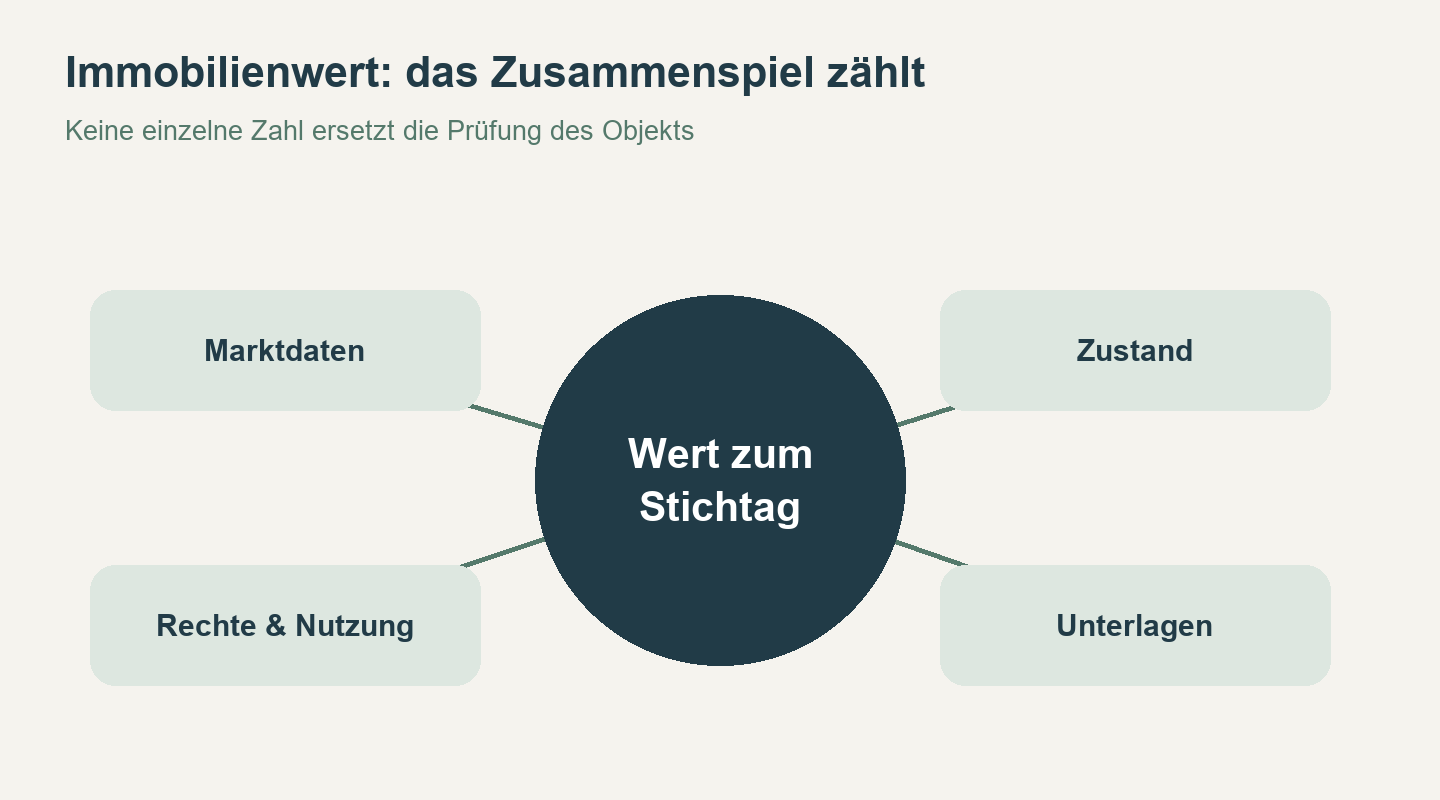
A real estate valuation should provide a comprehensible assessment of the value of a specific property at a particular point in time. Relevant factors include the location, condition, possible uses, legal encumbrances and reliable market data. An asking price in a listing or an online calculator alone does not provide a complete basis for this assessment.
As of September 2026. This introduction explains the valuation methods, the required documents and the difference between an initial market price estimate and a formal valuation report. It does not contain current price-per-square-metre data or a valuation of any particular property.
Distinguishing Market Value, Asking Price and Sale Price
Under Section 2 of the Austrian Property Valuation Act, market value describes the price that can be achieved under ordinary market conditions. Personal memories or a particular individual’s preferences are not taken into account. An asking price, by contrast, is the price expectation at which a property is offered on the market. The actual agreed purchase price is only determined once the parties reach an agreement. Legal basis for market value: Section 2 of the Austrian Property Valuation Act.
For sellers, this means that a neighbouring property advertised at a particularly high price is not sufficient evidence of the value of their own house. Ask whether comparable prices were actually achieved, how old the data is and which differences were taken into account.
Which Valuation Methods Are Used?
The Austrian Property Valuation Act specifically refers to the comparative value, income value and cost value approaches. The Act applies directly to the judicial and certain administrative valuations described there; this does not mean that every private sale estimate constitutes a court valuation report. Source: Austrian Property Valuation Act, in particular Sections 1 and 3 to 7.
Comparative Value: Which Similar Properties Were Sold?
This approach uses the actual prices achieved for comparable properties as its starting point. Differences in location, condition and time of sale, for example, must be taken into account. A mere collection of current listings is not sufficient for a reliable comparison.
When reviewing an estimate, ask about comparability: Does the other apartment have an elevator, terrace or parking space? Is it rented out? Have renovations already been paid for, or are major works still required? Such differences should be visible in the reasoning.
Income Value: What Sustainable Income Can Be Expected?
This approach considers the income that can be generated in the future, taking expenses, risks and useful life into account. A high gross rent alone does not prove a high value. Also review the underlying leases, ongoing expenses and vacancy assumptions.
Ask whether the current rent can actually be achieved over the long term. Particularly low or temporarily high rent can influence the result. Simple calculations such as “annual rent multiplied by a fixed factor” conceal these assumptions.
Cost Value: What Contribution Do the Land and Building Make to the Value?
The cost approach takes the land, buildings and other components into account. Age, condition and other value-influencing circumstances are included. The original construction costs or the total of all renovation invoices therefore do not automatically correspond to today’s market value.
For the discussion, record which works were carried out and when. For example, an invoice for the heating system does not establish the condition of the roof, windows, pipes or moisture protection. Distinguish documented modernisations from measures that will be required in the future.
Which Information Should You Prepare?
Helpful preparation consists of an organised property file. The specific documents required depend on the house, apartment or plot of land and on the purpose of the valuation.
- Current land register extract and documents relating to rights or encumbrances.
- Plans, comprehensible floor-area information and details of the approved use.
- Year of construction, documented alterations and known defects.
- Energy performance certificate and any available heating and operating-cost statements.
- For an apartment: valuation report for the apartment ownership, apartment ownership agreement, reserve fund balance and information on planned renovations.
- For a rented property: lease, actual income and expenses, and relevant ancillary agreements.
Clearly identify any missing documents. An unverified floor-area figure should not silently be treated as exact. Photographs can help with preparation, but they do not replace an examination of concealed features or characteristics that can only be identified on site.
Online Estimate or Individual Valuation Report?
An online result can provide an initial indication. Check which data was entered and whether the special characteristics of your property are actually reflected. A right of way, an unauthorised extension or an unusual lease cannot be reliably captured simply by entering a postcode and living area.
Clarify the intended use before commissioning the valuation. For planning a sale, you may need a different type of assessment than for a legal dispute, inheritance proceedings or evidence submitted to an authority. Therefore, agree on the qualifications, documentation and format required by the recipient. A non-binding estimate should not be described as a formal expert valuation report.
Why Two Valuations May Differ
Do not compare only the final amounts. Ask for the respective assumptions and underlying information. A difference can often only be properly understood by asking:
- Was the same valuation date used?
- Are the same areas and documents being used as a basis?
- Were the condition and renovation requirements assessed in the same way?
- Was the property assumed to be vacant or rented?
- Do the statements refer to market value or to a proposed asking price?
A mathematically precise amount is not evidence that the underlying data is equally precise. Where information is uncertain, ask for the uncertainty and its possible impact to be explained instead of focusing on a single figure.
Example: Two Apartments with the Same Floor Area
Imagine two apartments in the same location, each measuring 80 square metres. One has a practical layout, documented renovation work and an elevator. The other requires major work and important documents are missing. Despite having the same floor area, a different assessment may be objectively justified.
This example does not allow a fixed percentage increase or reduction to be derived. It merely shows why floor area and location alone are insufficient for an individual valuation. The specific differences must be assessed on the basis of the property and the available market data.
Frequently Asked Questions About Real Estate Valuation
Is a Valuation a Guarantee of the Sale Price?
No. An estimate supports the pricing decision, but it does not guarantee a buyer or a particular transaction. Supply, demand, contractual terms and the specific negotiations all affect the outcome.
Does Every Renovation Increase the Value by Its Cost?
You should not assume this. Keep invoices and technical records and have the impact of the measures assessed in the context of the property as a whole.
How Up to Date Must a Valuation Be?
The reference to a specific valuation date is important. Have the assessment reviewed if the property, its use or the market conditions relevant to the sale change significantly.
How Much Does a Real Estate Valuation Cost?
Clarify the scope of services in advance: an inspection, document review, written reasoning, formal valuation report and special intended uses may involve different levels of effort. Ask for a specific quotation for the fee and the services included.
Prepare the Sale on a Comprehensible Basis
First collect the property documents and record the reason for the valuation and your timeframe. In the next step, you can clarify any open questions and agree on the appropriate scope of the assessment. Information about support is available from Simon Immobilien for selling real estate. For an initial consultation, you can get in touch.
This article was created with the assistance of AI. It is intended solely as general, non-binding information about real estate valuation in Austria. It does not contain an individual valuation and does not replace an expert report tailored to the specific purpose, nor legal, tax or financing advice. Special property characteristics and changing market conditions may lead to different results. No guarantee is given as to the accuracy, completeness or applicability of the information in any specific case. No specific sale price is guaranteed. Statutory liability remains unaffected.
Personal consultation
Questions about your property? We take the time.
Whether buying, selling, valuation or financing — let's discuss your situation in a non-binding appointment.