
Law & Taxes
Broker liability in property purchases: false information, defects, damages
Anyone who relies on information from a real estate agent when buying property and later discovers a defect rightly asks who is liable. This guide clarifies the legal basis, the limits of broker liability and practical steps to take in Austria.
Last updated on 27 October 2026
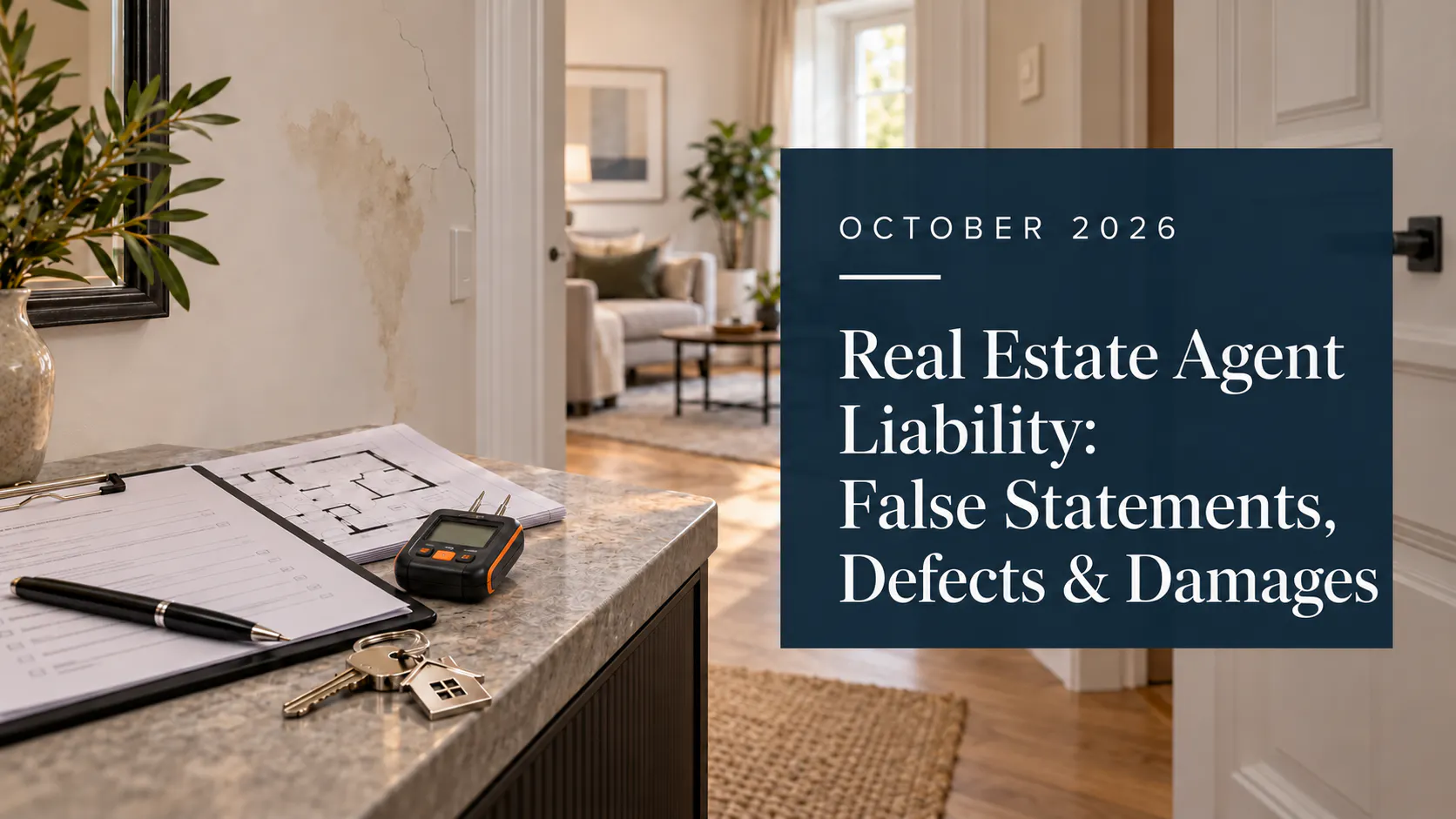
A buyer signs the purchase contract, moves in, and a few months later discovers that the basement is damp or that the living space stated in the listing doesn’t match reality. The first question is almost always: should the broker have known about this, and who bears the damage? The answer depends on many details that are often overlooked in practice.
Before considering legal action, it’s worth taking a structured look at the listing (Exposé), the brokerage agreement, the purchase contract and the communication that took place before closing. Simon Immobilien helps clients make sense of such documents and points out which aspects matter for a first assessment – though this is not a substitute for legal advice in the strict sense, which only a lawyer can provide.
Key points at a glance
- In Austria, brokers are generally only liable for statements they themselves made or should have recognized as incorrect – not automatically for every defect in the property.
- Broker liability must be clearly distinguished from the seller’s warranty obligations and liability for damages; both liability tracks run in parallel.
- The central legal bases are the Austrian Brokers Act (Maklergesetz), the General Civil Code (ABGB), and general disclosure duties under civil law.
- What often matters most is whether the broker knew about a defect, should have known about it, or was entitled to rely on information provided by the seller.
- Written documentation of the listing, viewing records and email correspondence is the most important evidence in case of a dispute.
- If false information is suspected, prompt legal advice is recommended, since the time limits for warranty claims and damages claims are limited.
What broker liability is about
Broker liability concerns the extent to which a real estate agent can be held legally responsible for false, incomplete or misleading information about a property. This becomes relevant above all when a buyer discovers, after signing the contract, that information in the listing, in verbal consultations or in documents did not match reality – for example regarding living space, the condition of the building structure, existing encumbrances in the land register, or the zoning status of a plot.
Under the Austrian Brokers Act (MaklerG), brokers are obliged to inform both parties to a contract carefully and truthfully. They hold a special position of trust, because buyers often don’t have direct access to all documents and rely on the information provided by the intermediary. At the same time, a broker is not a guarantor for the accuracy of every statement made by the seller – brokers owe diligence, not omniscience. For many people affected, this distinction is the most difficult point to grasp, because they initially assume the broker is “automatically” liable for everything stated in the listing.
This topic is relevant for buyers of apartments, houses and plots of land, as well as for sellers, who themselves can be held accountable if they provide the broker with false information. Tenants can also be affected if information about a rental property – such as usable floor area or operating costs – turns out to be incorrect, with the Austrian Tenancy Act (MRG) setting additional rules in that context.
Terms and distinctions that bring clarity
Broker liability versus the seller’s warranty obligation
Warranty obligations under the ABGB concern the relationship between buyer and seller. They apply when the purchased property has a defect at the time of handover, regardless of whether the seller was aware of it. Broker liability, on the other hand, concerns the relationship between the buyer or seller and the intermediary broker. It generally requires fault – the broker must have passed on false information, concealed something, or negligently failed to verify something that could reasonably have been checked. Both types of claims can exist in parallel, but one does not automatically include the other.
Duty to disclose and duty to investigate
Brokers must inform buyers of circumstances that are material to the purchase decision and that are known to them or that should be known to them with ordinary diligence. There is no unlimited active duty to investigate – a broker is not obliged to have every structural component independently inspected by an expert. However, brokers may not ignore plausible contradictions, for example when a seller claims the roof was “recently renovated” but visible signs of moisture in the attic suggest otherwise.
Fraud and gross negligence
A particular issue is whether a broker acted fraudulently – that is, deliberately concealed a defect to avoid jeopardizing the sale. Fraud leads to significantly stricter liability and can also render contractual exclusions of liability void. Gross negligence – for example, uncritically passing on clearly implausible claims – is often treated almost as strictly under the law as intent.
The listing as a legally relevant document
The property listing (Exposé) is more than a marketing tool. Statements in it, such as square meters, year of construction or energy performance, can be treated as warranted characteristics if they are specific and verifiable. General promotional phrases such as “flooded with light” or “quiet location,” on the other hand, are usually regarded as non-binding advertising language without independent liability value.
What actually matters in the assessment
Whether broker liability actually applies depends on several factors that must be examined case by case:
- Broker’s level of knowledge: did the broker positively know about the defect, or should they have recognized it during a typical property viewing?
- Source of the information: does the statement in question come directly from the seller, from an energy certificate, from the land register, or from the broker’s own assessment?
- Specificity of the statement: is it a precise, verifiable claim or a general, promotional phrase?
- Documentation: is there written evidence, such as emails, listings, viewing records or chat logs?
- Causality: did the incorrect information actually influence the purchase decision, or would the purchase have gone ahead even with correct information?
- Contributory negligence of the buyer: was a reasonable independent check, for example by a building expert, omitted despite indications that should have raised doubt?
These criteria show that blanket statements are rarely accurate. Two cases involving similar damage can be assessed completely differently under the law, depending on how the chain of information unfolded in each specific case.
| Scenario | Typical liability | Remark |
|---|---|---|
| Broker passes on incorrect living space as stated by seller, without checking | possible, if implausibility was recognizable | proof of recognizability is decisive |
| Broker conceals a known water damage issue | likely, possibly fraud | strong evidentiary weight if documented |
| Seller deceives the broker, who passes on the information in good faith | liability tends to fall on seller | broker must be able to prove good faith |
| Buyer declines an expert report despite being advised to get one, and later discovers a defect | lower chance of success | contributory negligence will be examined |
Step by step: what to do if you suspect false information
- Secure documents: compile the listing, brokerage agreement, email correspondence and purchase contract in full; this typically takes one to two hours.
- Document the defect: take photos and, if necessary, obtain a report from a building expert; this usually takes one to three weeks depending on availability.
- Initial contact with the broker: send a written request for clarification of the information provided; a response is typically expected within a few business days.
- Obtain an initial legal assessment: consult a lawyer, ideally one specializing in real estate law.
- Check deadlines: clarify warranty periods and limitation periods for damages claims together with your legal representative.
- Attempt an out-of-court settlement: many cases are resolved through agreement between the parties; duration varies greatly by case.
- Court proceedings as a last resort: if no agreement can be reached, consider filing a lawsuit; proceedings in Austria can take very different amounts of time depending on complexity and court.
This sequence is practical guidance, not legal instruction. Which steps are sensible or necessary in a specific case should always be discussed with qualified legal counsel.
Illustrative case example
A couple buys a condominium in Vienna, with a purchase price of 420,000 euros according to the contract (a reference figure chosen freely for illustration). The listing mentioned a “recently renovated bathroom and modern heating system.” After moving in, it turns out the heating system is over twenty years old, with estimated repair costs of 8,000 euros (reference figure).
In this scenario, legal counsel would first examine whether the claim “modern heating system” originated with the seller and was passed on by the broker without verification, or whether the broker personally inspected the system and made the statement independently. If the latter is true, and the age of the system was recognizable to someone with relevant expertise, co-liability of the broker may come into consideration. At the same time, the seller’s warranty obligation remains in place, provided the warranty period is still running.
For comparison, a second scenario: the same apartment, the same defect, but beforehand the broker had stated in writing that information about the heating system was passed on unverified from the seller and recommended a technical inspection. In this case, the likelihood of successfully establishing broker liability drops significantly, because the broker fulfilled their duty of care and disclosure. This example shows how strongly the documentation of individual statements can influence the outcome.
Common mistakes and how to avoid them
- Failing to get verbal assurances confirmed in writing: statements made during a viewing should be summarized by email and confirmed by the broker, otherwise there’s no proof later.
- Skipping an independent inspection: anyone who fails to obtain an expert report despite recognizable uncertainties risks contributory negligence, which can reduce later claims.
- Overlooking deadlines: warranty periods and limitation periods run independently of when the defect was discovered; acting too late can cost you your claims.
- Confusing broker liability with seller liability: pursuing the wrong party wastes valuable time while deadlines continue to run.
- Overestimating listing language: general promotional phrasing rarely establishes an independent basis for liability, which leads to false expectations.
- Skipping legal advice before signing the contract: many disputes could be avoided if purchase contracts and assurances were reviewed by a professional beforehand.
Checklist: assessing broker liability correctly
- Archive the complete listing and all promotional materials
- Have verbal assurances confirmed in writing
- Obtain an independent expert report if you have doubts about technical claims
- Check the brokerage agreement for liability clauses and exclusions
- Have the purchase contract reviewed by a lawyer before signing
- Note warranty deadlines and mark them in your calendar
- Respond promptly and in writing if a defect is discovered, don’t wait
- Always document communication with the seller and broker
- Seek legal advice early if you’re unsure
Frequently asked questions
Is the broker automatically liable for every defect in the property?
No. Broker liability generally requires fault on the broker’s part, such as passing on false information that the broker knew about or should have recognized. For structural defects unknown to both seller and broker, the seller’s warranty obligation is more likely to apply than broker liability.
What is the difference between broker liability and warranty?
Warranty concerns the relationship between buyer and seller and relates to the objective condition of the property. Broker liability concerns the relationship with the intermediary and generally requires a breach of duty by the broker. Both types of claims can exist side by side.
Can I rely on the information in the listing?
Specific, verifiable information such as living space or year of construction carries greater legal weight than general promotional phrasing. Even so, a listing is no substitute for your own due diligence on important decisions, especially with older properties or when the facts are unclear.
What deadlines do I need to be aware of?
The deadlines for warranty claims and damages claims are governed differently and depend on the specific case, for example whether a defect was hidden or openly visible. A binding assessment of the specific deadlines can only be provided by a lawyer in the individual case.
What should I do if I suspect false information was given?
First, secure all relevant documents and document the defect. After that, it’s advisable to contact the broker for clarification while simultaneously seeking an initial legal assessment, so that deadlines don’t pass unused.
Does broker liability also apply to rental properties?
Generally, yes – brokers also have disclosure duties when arranging rental agreements, for example regarding usable floor area or operating costs. Here, additional provisions of the Austrian Tenancy Act (MRG) further shape the relationship between tenant and landlord.
How Simon Immobilien can help
Simon Immobilien supports buyers and sellers with carefully prepared listings, transparent property valuations and clear communication throughout the entire brokerage process. If you have questions about documents, viewing records, or how to interpret information before a purchase, the team is available for an informal conversation – though this does not constitute legal advice in the strict sense. If you have a specific concern, you can find the right contact person via the Simon Immobilien contact page, and it’s also worth browsing the current property listings as well as further articles in the property guide.
This article is for general information purposes only and does not replace individual legal advice from a qualified lawyer.
More from Law & Taxes
- Austrian ImmoESt on legacy property: Sell in 2026 and save up to 1.8% of the proceedsRead more arrow_forward
- Land Register in Austria 2026: Registration, Deletion and Fees ExplainedRead more arrow_forward
- Priority Ranking in the Land Register: Protection Against Double SalesRead more arrow_forward
- The Land Registry Consent Declaration in Austrian Property Purchases: Why Careful Review MattersRead more arrow_forward
Personal consultation
Questions about your property? We take the time.
Whether buying, selling, valuation or financing — let's discuss your situation in a non-binding appointment.